

Gm gents. I’ve ran well over 100 blood panels at this point. Most on clients. The rest on me. Biggest lesson: symptoms are the last thing to show up when health starts going sideways. Its like balding, by the time you notice the Norwood you’re already cooked.
The gap between what people think is going on inside them and what’s actually going on is wild. I used to think I could trust my intuition. Felt great, looked decent, training was solid. Why bother with bloods?
Biohacking without labs works until it doesn’t. The more you experiment, the more you must test.
I run labs every quarter. Specialty panels once a year. In this article I’ll go over:
Why you need labs in the first place
What labs to get (and what they show you)
My personal lab results (very average but at least will prove I’m not on steroids)
Shoutout to Superpower for sponsoring this post. I’ve been getting panels from them since 2024. Code SUPERNOAH at checkout gets you free at-home blood draws with your membership. (Sign up here)
Lets commence.
The Subjective Feeling Trap
Your body is incredibly good at feeling “good enough.”
You hear it every year. Some celebrity announces stage 4 cancer out of nowhere. Alzheimer’s symptoms typically don’t show up until significant brain atrophy has already happened. Heart attacks in guys who looked fit a week earlier.
There’s too much latency between how you feel and what is actually happening at the cellular level. Symptoms are the body’s last resort. The effects you get from interventions, whether good or bad, show up on labs before they show up on your body .
Once you start running labs you never go back. There’s no better feeling than seeing a protocol reflect itself on your labs. It gives you a sense of agency spamming powders never will.
You Cant Fix What You Can’t See
Every protocol you run should leave a fingerprint on your blood. If you don’t have a baseline and a follow-up, you have no control group. You’re guessing whether the stuff you’re injecting worked, whether the supplement you saw on Twitter is doing anything, whether your giga-chad training actually moved the needle. Its the same reason concussion testing works the way it does. You need a baseline reading from when things were normal, otherwise you have no idea what “normal” even is for you.
Keyword is normal for you. Genetic variability is real. Some guys simply need less testosterone. Others run at perma-high cholesterol. How do you know if your labs are a result of your protocols or just the way you are? This is why we baseline test
Most Disease Starts In Your 20s And 30s
Most of what kills people in their 50s and 60s shows up in bloodwork decades earlier.
Insulin resistance, fatty liver, and artherosclerosis slowly creeps up. These are 10+ trajectories. You catch them by tracking, not by getting a colonoscopy after pooping blood.
Easier to stay lean than to un-fat yourself. Same principle applies to every chronic condition. Course correcting before an incident is 100x cheaper, easier, and less painful than recovering after one. Most people lack this forward thinking (don’t be most people).
Labs Are Cheap Now. Like Really Cheap
I used to not test simply because it was too expensive. Panels used to require a referral, doctor visit, and a 3 week wait. Even if you got approved for them, you got maybe 12 biomarkers. Now you can order hundreds of biomarkers from your couch for less than what most guys spend on Doordash.
What To Test
On average, I’m testing 8 categories
1. Metabolic markers
Fasting glucose, fasting insulin, HbA1c, uric acid.
Metabolic markers are a window into how efficiently your body handles energy. This is always my first priority considering my metabolic protocol focus. These tell you how metabolically flexible and insulin sensitive you are.
A lot of people only look at glucose when its often the last thing to become abnormal. Fasting insulin and HbA1c are more important in my opinion.
2. Lipids & Cardiovascular Health
ApoB, Lp(a), full lipid panel (HDL, LDL, triglycerides), hs-CRP, homocysteine.
Lipids look at how much fat is moving through the bloodstream, how its being handled, and blood vessel health. They also provide insight into metabolic health (cardiovascular health is closely tied with metabolic health)
ApoB is more predictive than LDL because it counts the actual atherogenic (clot-forming) particles in your blood, not just the cholesterol they carry. Lp(a) is genetic, mostly fixed, and you only need to test it once. If its high, you need to be lasered in on CV health. Hs-CRP catches inflammation. Homocysteine catches B vitamin status and methylation issues. Boring markers, but super important.
3. Hormones
Total testosterone, free testosterone, SHBG, estradiol, LH, FSH, DHEA-S, prolactin, progesterone.
Hormones are so much more than Testosterone. All of these have crucial functions and show how well your body is signaling as a whole.
Total testosterone means nothing if your E2 (estrogen) is crashed, prolactin is spiked, or sex hormone binding globulin is through the roof. After a few labs, you’ll find your “culprit”. For me its actually LOW estrogen (which is probably why I like beer) and high SHBG (which is why I like boron).
4. Thyroid
TSH, free T3, free T4, T3 uptake, TPO antibodies, thyroglobulin antibodies.
TSH alone is not enough. Plenty of guys with normal TSH have terrible free T3 (the active, needle-moving thyroid hormone. You can try and boost thyroid hormone all you want but if your body’s attacking your thyroid (shown by antibodies), nothing will move the needle.
Tired, cold, unexplained weight gain. All linked to thyroid. Thyroid is a delicate organ. It takes the brunt of damage from a toxic lifestyle. There’s a reason health Twitter is so obsessed with this organ. Every subjective complaint usually has thyroid as an up or downstream issue.
5. Liver
AST, ALT, GGT, alkaline phosphatase, bilirubin (total, direct, indirect), albumin.
My personal favorite. Your liver is your detox hub, hormone-processing organ, metabolic processing plant, and nutrient conversion center. Hardest working organ in your body and it deserves its flowers
Liver enzymes catch fatty liver, alcohol damage, supplement-induced hepatotoxicity, and a dozen other issues. GGT specifically is one of the best early warning markers for oxidative stress and toxin burden. If you’re biohacking, boozing, or taking pharmaceuticals, test your liver thoroughly and often.
6. Kidneys
Creatinine, eGFR, BUN, BUN/creatinine ratio. Urinalysis easy bonus for infections, dehydration, protein leakage, and stuff that points to bigger problems upstream.
Kidneys get nuked by chronic hyperglycemia, processed food, sleep deprivation, and sedentary lifestyle. Everybody knows an old person that died from kidney failure. If you don’t care about dying just know that bad kidneys also make you ugly and give you brain fog.
7. Inflammation & Immune
hs-CRP, ESR, full CBC with differential, ferritin.
Chronic low-grade inflammation is a pro-disease state. CBC tells you about red cells, white cells, platelets. Differential breaks down the immune cells. Ferritin is typically considered an iron storage marker but also indicates inflammation.
Inflammation is not bad, inappropriate inflammation is bad. Being inflammed is an energetically demanding state. It interferes with healthy signaling. It is the substrate for a whole can of other things to go bad. Lowering inflammation may not solve all your problems, but good luck solving your problems while inflammed.
8. Nutrient Status
Vitamin D, B12, folate, ferritin, magnesium (RBC, not serum), zinc.
You cant out-supplement a deficiency you haven’t measured. And you cant out-supplement an excess either, which is more common than people realize. Overnutrition is just as problematic as undernutrition.
Reading my Labs: The Most Underrated Biomarkers
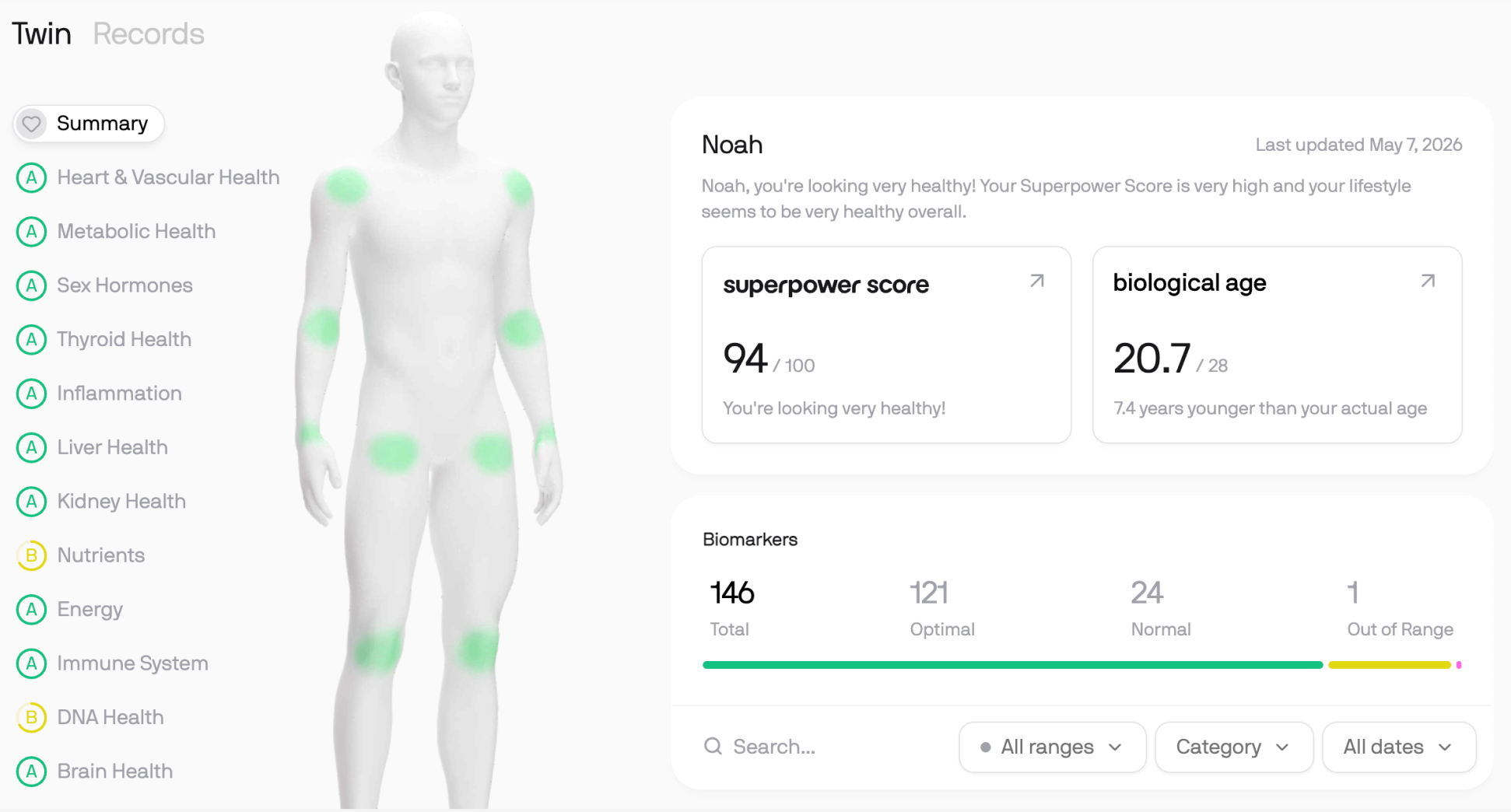
Now I’ll go through my most recent labs (which I passed in flying colors btw). Here are the first markers I gravitate toward:
Fasting Insulin
The single best marker for metabolic health. My current reading is 3.0 uIU/mL. Optimal is under 5. Glucose can stay normal for years while insulin gets out of hand. By the time glucose starts drifting, you’re already pre-diabetic (and have been for a while). This is my northstar for shredmaxxing.
ApoB
Mine is 79 mg/dL. Optimal is under 90, with under 80 being the target for anyone serious about long-term cardiovascular risk.
ApoB counts the actual particles that drive plaque formation. LDL is a rough estimate of the cholesterol inside those particles. Two people can have identical LDL and wildly different ApoB.
Hs-CRP
Mine is <0.2 mg/L. Under 1.0 is optimal, under 0.5 is excellent.
This marker shifts fast in response to lifestyle. Bad sleep, bad food, bad relationships, chronic stress, all of it shows up here. Its a near-real-time read on whether your body is struggling. I’ve been aggressively combating systemic inflammation after CIRS and seeing it reflect in my hs-CRP is vindicating.
Lp(a)
Mine is 36 nmol/L. Under 75 is optimal.
This one is mostly genetic. You test it once in your life. If its elevated, you treat your cardiovascular health more aggressively from that day forward. If its low, you have one less thing to worry about.
Free Testosterone + SHBG
Total T is great, but Free Testosterone and SHBG show you what you can actually use
Mine: total T 807 ng/dL, free T 100.7 pg/mL, SHBG 39 nmol/L. The SHBG is on the higher end of normal, which means a chunk of my total T is bound and not bioavailable, hence I’m increasing my boron, carbs
Homocysteine
Mine is 7.5 umol/L. Under 8 is the functional target. Reference ranges go up to 12.9, which is too lenient.
High homocysteine is one of the strongest independent predictors of cardiovascular events and cognitive decline. Its also one of the easiest things to fix with B vitamins, methylation support, and lowering inflammation.
Vitamin D
Mine is 58 ng/mL. Optimal is 50-80. Anything under 30 is a deficiency.
Most people who dont supplement and dont live in the sun are sitting in the 15-25 range. Massive immune, hormonal, and mood implications. Do not fade Vitamin D.
Free T3 (+ TPO & thyroglobulin antibodies)
Mine is 3.7 pg/mL. Optimal is 3.1-4.2.
Free T3 is what you can actually use. Not T4, not Total T3. Free T3. If you want to FEEL your metabolism churning, make sure free T3 is optimized. This is the real unlimited energy hormone.
No amount of thyroid optimization matters if your body is attacking itself. TPO & thyroglobulin antibodies catch autoimmune thyroid disease years before TSH starts shifting.
What My Labs Are Saying
Wins:
Fasting insulin at 3.0. Metabolic health is locked in.
hs-CRP under 0.2. Inflammation is basically undetectable.
Total T at 807 with free T at 100.7. Total is decent, free is a little low.
ApoB at 79, HDL at 74, triglycerides at 69. Lipids are clean across the board.
Lp(a) at 36. Genetic CV risk is low.
HbA1c at 4.9. Blood sugar control is dialed.
Vitamin D at 58. Solid without being excessive.
Homocysteine at 7.5. Methylation is working.
What I’m doing differently next quarter:
Working on lowering SHBG. Boron, more carbs, lower stress
Adding an advanced toxin panel since I just moved out of a mold situation and like to reassess
Getting a full-body scan because why not.
This is the whole point of running blood panels frequently. You see what works and what doesn’t on a consistent cadence. You don’t have to get everything tested all the time, but get the big guys tested and, if needed, they can point you toward deeper testing needs.
General Lab Protocol Etiquette
Frequency:
Quarterly if you’re actively experimenting with protocols, peptides, or aggressive supplementation.
Twice a year if you’re running a stable stack and want trend data.
Annually as the absolute minimum for anyone over 25.
Conditions:
Fasted 12 hours minimum.
Morning. Cortisol and testosterone peak early & consistent timing is important
Before training. Even moderate exercise shifts markers.
Before supplements. I recommend not taking anything a day before as well.
Consistency:
Same lab when possible. Reference ranges and assay methods vary, which can make tracking trends harder than it needs to be.
Same conditions every time. Same time of day, same fasted state, same activity level the day before.
I personally avoid lab clinics at all costs. Feel like I’m doing court mandated drug testing. I get a phlebotomist to come to my house. Absolutely worth it.
Free At-Home Labs With Superpower (Code SUPERNOAH)
I’ve been using Superpower for labs since moving back to the US in 2024. They test 100+ biomarkers from a single draw. A standard physical covers about 15 to 20.
You get:
100+ biomarkers in one panel.
At-home phlebotomy. Schedule it, they come to you, 10 minutes.
A dashboard that translates raw numbers into a plan, in plain language.
Concierge medical team available through the year for questions.
Biological age vs calendar age comparison (genuinely fun to see).
Personalized recommendations for sleep, energy, longevity, recovery, and prevention (super important)
Superpower runs labs effectively at cost AND is giving Health HQ members free at-home lab testing with their membership. Normally a $120 add-on. Use code SUPERNOAH here
p.s. If you want me to run through your labs with you and set up a custom protocol, you can book a time here
I’ve been using Superpower my the past two blood draws and have been impressed with their app, particularly the AI insights.
I connected my Oura ring and they now email me proactively with tips and advice when they notice concerning trends or issues like time zone shifts.
Cystatin C for kidneys